Caesar Delusion 01| Structure: The Cage of American Bipartisanship
Why Third Parties Always Die

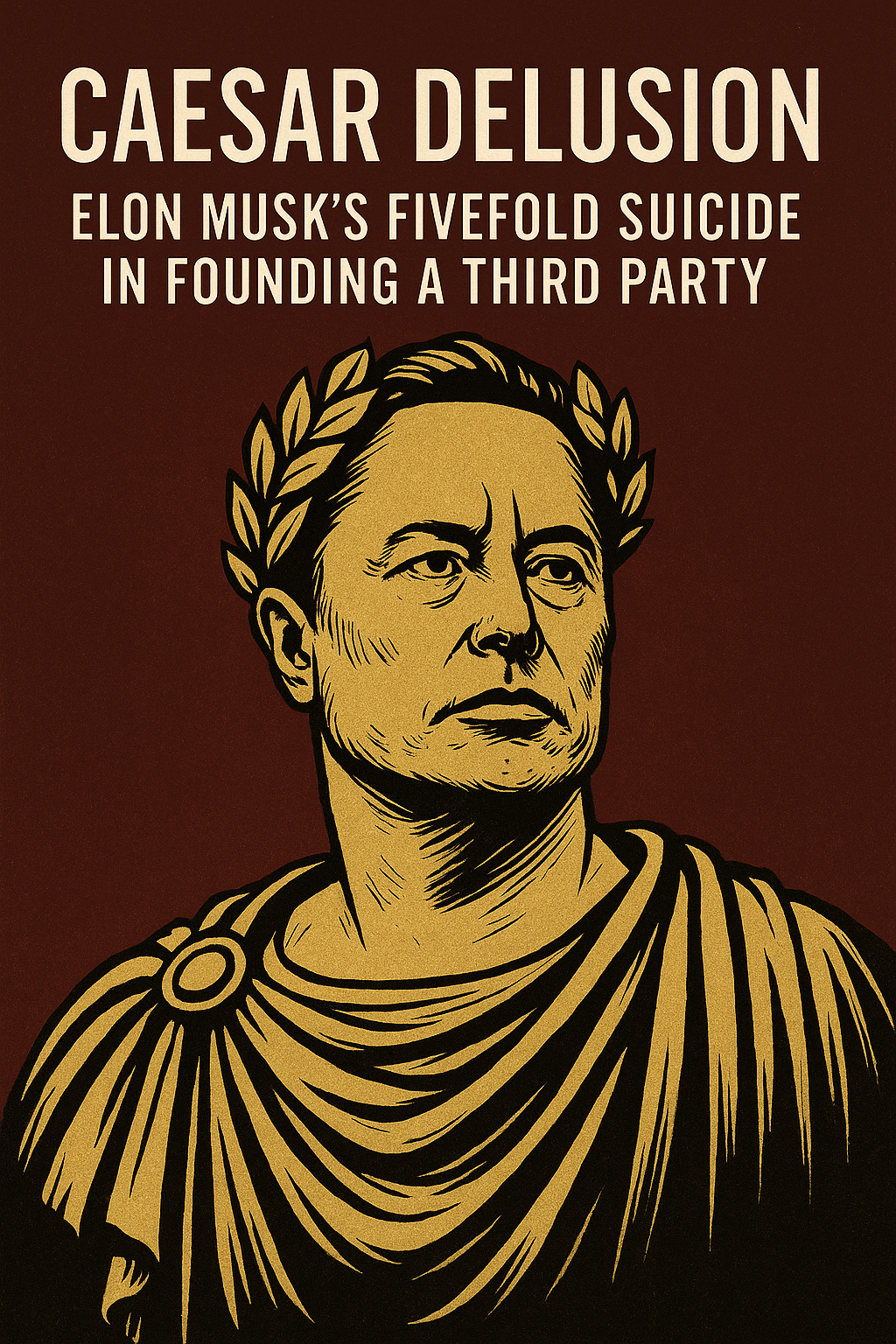
In America, the two-party system is not a preference. It is a mechanism.
It is tempting to think of parties as brands that rise and fall with the mood of the people. But in the United States, the two-party system is more than a legacy — it is a fortress of structure, law, and mathematics. Every serious third-party effort in modern history has broken itself against its walls.
First, the structural barriers:
- The Electoral College:
Winner-takes-all states mean a third party must win entire states outright — not just a share of votes. - First-past-the-post voting:
There are no second chances. No runoffs. No proportional representation. Plurality wins, and the rest vanish. - Ballot access laws:
Different in every state. Complex, costly, time-sensitive. Designed to filter out noise — and they often do. - Media binary:
Debates, polling, funding, coverage — all built for red or blue. Anything else is ignored, ridiculed, or treated as sabotage.
Second, the history:
- Ross Perot, the billionaire independent who polled in double digits and still won zero electoral votes.
- Ralph Nader, whose Green candidacy in 2000 arguably cost Al Gore the presidency — and gave “spoiler” its modern political meaning.
- The Libertarians, the Greens, the Forward Party — all well-intentioned, briefly relevant, then institutionally erased.
Every third party becomes, in effect, a vote thief — a spoiler that steals just enough to lose, while handing power to the very side it opposes. This is known as the spoiler effect, and it’s not a glitch — it’s baked into the system.
And here’s the fatal flaw: Musk doesn’t understand any of this.
To him, politics is a product. Parties are platforms. The electorate is a user base to be disrupted. He sees the Republican and Democratic parties not as institutional networks with layered interests and historic constituencies, but as outdated apps ready for replacement.
He imagines that, with enough followers, enough algorithmic force, and a well-designed interface, he can launch a new political operating system.
But he is not launching a product. He is walking into a minefield. Worse: he is doing so in ignorance of its history and structure.
He is a man trying to jailbreak a fortress with a tweet.
The American two-party system is not dying. It is defending itself. Violently, if necessary. Every third-party dream becomes a nightmare when it meets the machinery of this deeply entrenched order.
Musk will not reinvent democracy. He will collide with its hardware.